
Economists say there aren't many options with the government at present, given the drought-like situation which would only spur its spending.
Anil Ambani met Cabinet Secretary K M Chandrasekhar, Expenditure Secretary Sanjiv Misra and Fertiliser Secretary J Sreedhara Sarma to drum support against RIL's proposed pricing formula for natural gas from KG-D6 block off the east coast.
Reliance Industries Chairman Mukesh Ambani met top government officials on Tuesday, including Cabinet Secretary and Principal Secretary to the prime minister, to explain his company's approach to pricing of natural gas to be produced from KG basin.

In his address, CJI Chandrachud recounted his journey, from sitting in the last row of the court as a young law student to his time on the revered corridors of the top court.

He could have blazed a trail that few Indian judges had. It was a missed opportunity of a lifetime, notes Ramesh Menon.

The review pleas filed by advocate Mathews J Nedumpara and others contended that the matter related to the scheme falls in the exclusive domain of legislative and executive policy.

On February 1, grappling with the intractable issue of the AMU's minority status, the top court said the 1981 amendment to the AMU Act, which effectively accorded it a minority status, only did a "half-hearted job" and did not restore the institution the position it had prior to 1951.

A five-judge constitution bench headed by Chief Justice D Y Chandrachud held that the 2018 scheme was 'violative' of the constitutional right to freedom of speech and expression and right to information.

The State Bank of India, which unsuccessfully sought extension of time till June 30 to disclose the details of electoral bonds, on Monday faced searching questions from the Supreme Court which wanted to know about the steps taken to comply with the directions it had issued while scrapping the controversial scheme of anonymous political funding on February 15.

The Supreme Court on Friday deferred the question of Aligarh Muslim University's minority status to a fresh bench and overruled the 1967 judgment that said the university cannot be considered a minority institution since it was created by a central law.

A five-judge constitution bench headed by Chief Justice D Y Chandrachud said there is "no manner of doubt" that the SBI is required to disclose complete details of the bonds.

Aligarh Muslim University is not a minority educational institution, Supreme Court's Justice Dipankar Datta said on Friday and noted had it not been a "race against time" he would have articulated better in his dissenting opinion. The judge also flagged a non-exchange of ideas and opinions in a "true democratic spirit" to build a consensus.

Democracy does not begin and end with elections and the integrity of election process is pivotal for sustaining the democratic form of government, the Supreme Court said on Thursday while striking down as unconstitutional the electoral bonds scheme for political funding.

It is crucial to electoral democracy that the exercise of freedom to vote is not subject to undue influence, the Supreme Court said on Thursday while striking down as unconstitutional the electoral bonds scheme for political funding.

India Inc on Thursday pitched for lowering income tax burden on common man, increase in capital expenditure, and firm steps to contain food inflation in their nearly two-hour long interaction with finance minister Nirmala Shitharaman ahead of the Union Budget. During pre-Budget consultation with Sitharaman, the industry leaders and associations also urged the government to focus more on infrastructure development with a view to maintaining the economic growth momentum. The industry leaders also laid stress on boosting the MSME (micro, small, and medium enterprises) sector, considered a backbone of the Indian economy and main employment generator.

Not ordering disclosure of details of electoral bonds prior to April 12, 2019, was a "conscious choice" by the Constitution bench, the Supreme Court said on Monday while refusing to entertain the submissions of ASSOCHAM and CII against the disclosure of bond details on the ground of their plea not being listed.
In a landmark judgment that delivered a big blow to the government, the Supreme Court on Thursday annulled the electoral bonds scheme, saying it violates the constitutional right to freedom of speech and expression as well as the right to information.

A voter's right to know is 'far too important' in democracy than the privacy of a donor, Supreme Court judge Justice Sanjiv Khanna said on Thursday as the apex court scrapped the 2018 electoral bond scheme for funding political parties.

Government unlikely to bring in an ordinance to address the developments arising out of the Supreme Court order.

The State Bank of India told the Supreme Court on Thursday it has provided all details of the electoral bonds in its possession to the Election Commission.

The apex court bench, also comprising justices Sanjiv Khanna, BR Gavai, JB Pardiwala, and Manoj Misra, will assemble at 10.30 am to hear the two petitions.

Holding that the electoral bonds scheme was not fool-proof, the Supreme Court said on Thursday that information about funds received by a political party is essential for voters to exercise their freedom to vote effectively.
The top court law officer said the power of judicial review is not about scanning state policies for the purposes of suggesting better or different prescriptions.
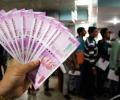
Future Gaming and Hotel Services whose director is the lottery magnate Santiago Martin is the top purchaser of electoral bonds having purchased bonds worth Rs 1,368, according to data uploaded by the Election Commission of India on its website on Thursday.

A charkha for the president, Benarasi sarees for Michelle & more!

Merely because an educational institution is regulated by a statute does not take away from it the character of a minority institution, the Supreme Court observed on Tuesday as it commenced hearing the vexed question of minority status of Aligarh Muslim University (AMU).

There is nothing "fundamentally inconsistent" with a minority institution being an institution of national importance (INI), the Supreme Court said on Wednesday while hearing arguments on the vexed issue of minority status to Aligarh Muslim University (AMU).
A five-judge constitution bench of the Supreme Court is scheduled to commence hearing from October 31 a batch of pleas challenging the validity of the electoral bond scheme for political funding of parties.
The Collegium's recommendations, if accepted by the Centre, will raise the total number of judges in the apex court to 33 against the sanctioned strength of 34 including the CJI.

A five-judge Constitution bench headed by Chief Justice D Y Chandrachud, which was hearing an application filed by the Election Commission (EC) seeking a modification of the operative portion of its March 11 order in the electoral bonds case, directed its registrar (judicial) to ensure that the data filed earlier by the poll panel before it in a sealed cover be scanned and digitised.

Chastising the State Bank of India, the Supreme Court on Monday ordered it to disclose the details of the electoral bonds encashed by political parties to the Election Commission by the close of the business hours on March 12 and warned the country's largest public sector lender that the court may proceed against it for 'wilful disobedience' if it failed to comply with its directions and deadlines.

Grappling with the intractable issue of Aligarh Muslim University's minority status, the Supreme Court said on Thursday the 1981 amendment to the AMU Act, which effectively accorded it a minority status, only did a "half-hearted job" and not restore to the institution the position it had prior to 1951.
An institution of national importance must reflect the "national structure", the Centre told the Supreme Court on Tuesday while pointing out that around 70 to 80 per cent students studying at Aligarh Muslim University (AMU) are Muslims even without reservation.
A five-judge Constitution bench of the Supreme Court is scheduled to commence a crucial hearing from Tuesday on a batch of pleas challenging the validity of the electoral bonds scheme for funding political parties.

The mere fact that some part of administration of an educational institution is also looked after by non-minority officials does not "dilute" its minority character, the Supreme Court observed on Wednesday while hearing the hugely disputed minority status of Aligarh Muslim University (AMU).

How does it matter for people whether the Aligarh Muslim University is a minority institution or not when it has continued to be an institute of national importance without the minority tag, the Supreme Court said on Thursday as it underlined that the intent of Article 30 of the Constitution is not to "ghettoise the minority".
'Corporates who donated to political parties were guaranteed by the electoral bond scheme that their names and to who they were donating funds will be not disclosed.'

The Supreme Court on Thursday directed the Election Commission of India (ECI) to produce before it in sealed cover the "up to date" data of funds received by political parties through electoral bonds till September 30, 2023.
'Mumbai main branch (SBI headquarter) has all the data ready-made. It doesn't take even an hour to out the data from the system.'
The Centre told the Supreme Court on Wednesday that almost every country, including India, was grappling with the problem of use of black money in elections and the electoral bonds scheme was a "conscious attempt" to eradicate the menace of "unclean money" in the poll process.
